

 Source: http://legacy.mos.org/oceans/life/surface.html
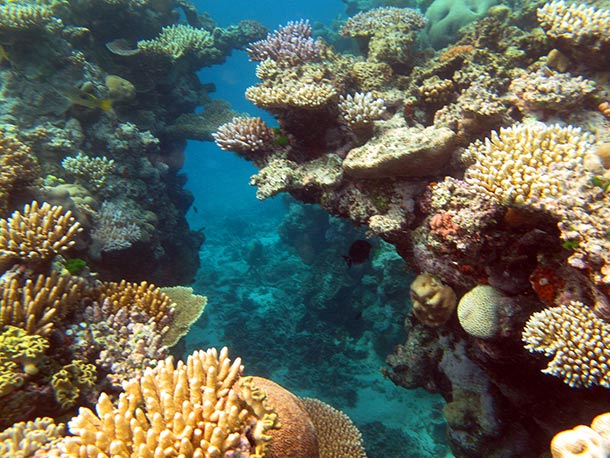
Most of the ocean is full of sea life, including the plants, ocean reefs, and sea creatures. They’re all out there, growing, spreading, and waiting for food to come their way. So, when you’re out swimming, you’re among the living.
 Source: http://www.atlasobscura.com/places/the-great-white-cafe
Most great white sharks hunt in shallow parts off the coasts of Hawaii and California. But once every year, at a certain spot between Hawaii and North America, great white sharks converge. Scientists call it the White Shark Cafe. What makes it even more terrifying is we don’t even know why. Some have speculated it is a mating ritual. However, they also are known to go down to extreme depths which is unlike them. This created the theory they go there every year to feast on giant squid. Either way, it’s a little creepy.
Can’t contain your insatiable curiosity of sharks? You need to check out 25 Facts About Sharks: Terrors Of The Ocean
4
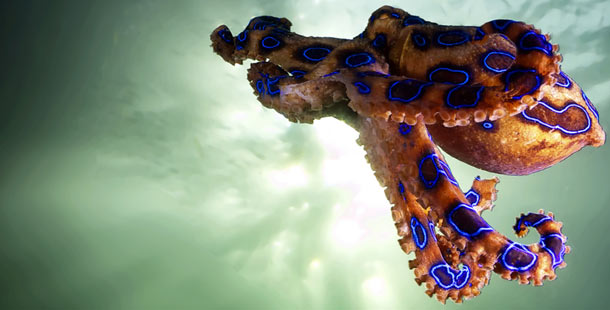
The Blue Ringed Octopus will totally kill you
 Source: http://www.thecephalopodpage.org/bluering2.php
If you’re in Australia, you may want to be aware of the Blue Ringed Octopus. It’s one of the deadliest sea creatures in the ocean. Because of its tetrodotoxin, it’s incredibly dangerous. When contact occurs, people rarely know they’ve been bit, and the symptoms come on rapidly. It only takes about 10 minutes for vomiting and total paralysis to manifest. Unless you have immediate medical attention, death is almost certain.
Photo: 25. Pixabay.com (Public Domain), 24. Pixabay.com (Public Domain), 23. Wikipedia Commons.com (Public Domain), 22. Steve Evans from Citizen of the World, Great Barrier Reef 008 (5387514565), CC BY 2.0, 21. Wikipedia Commons.com (Public Domain), 20. Pixabay.com (Public Domain), 19. Wikipedia Commons.com (public Domain), 18-16. Shutterstock, 15 Navy (Public Domain), 14. Terry Goss, White shark, CC BY-SA 3.0, 13. Avispa marina.jpg: Guido Gautsch, Toyota, Japan derivative work: Mithril (talk), Avispa marina cropped, CC BY-SA 2.0, 12. Pixabay.com (Public Domain), 11. Wikipedia Commons.com (Public Domain), 10. Wikipedia Commons.com (Public Domain), 9. Wikipedia Commons.com (Public Domain), 8. Shutterstock, 7. Tim Evanson, Coelacanth and pup – smithsonian, CC BY-SA 2.0, 6. Shutterstock, 5. Shutterstock, 4. Sylke Rohrlach from Sydney, Blue-ringed octopus (Hapalochlaena maculosa) (8593173385), CC BY-SA 2.0, 3. © Citron / CC BY-SA 3.0, Anoplogaster cornuta 2012, CC BY-SA 3.0, 2. Wikipedia Commons.com (Public Domain), 1. CSIRO, CSIRO ScienceImage 10801 Coastal development at Surfers Paradise, CC BY 3.0