

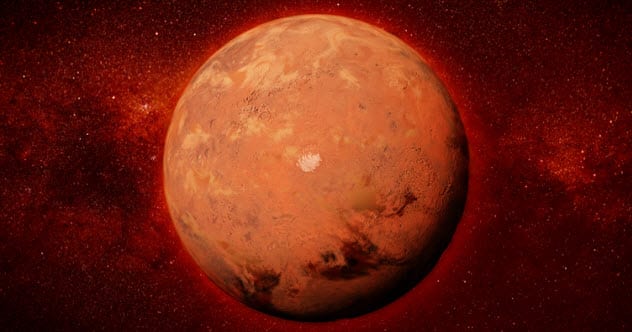
Of all of the planets in our solar system, Mars is likely the one that has fascinated humanity the most. Maybe it’s because it’s one of our closest neighbors and can be seen with the naked eye, but whatever the reason, the Red Planet has captured our imaginations for centuries.
We now know more about Mars than ever before, but there are plenty of odd facts about the planet that many people don’t know. Here are 10 such fascinating facts, from Mars being home to the solar system’s tallest mountain to a piece of the World Trade Center currently lying on the distant planet.
Related: 10 Surprising Ways Living on Mars Would Compare to Earth
10 John F. Kennedy Considered Mars Before the Moon
In his iconic 1962 speech, President John F. Kennedy declared, “We choose to go to the Moon. We choose to go to the Moon in this decade and do the other things, not because they are easy, but because they are hard.”
However, Kennedy had also asked NASA engineers about the feasibility of sending humans to Mars. Astronaut Buzz Aldrin later explained that, after calculations, NASA concluded that Mars was simply too far away with the technology available at the time, and that the Moon was a more realistic target.
The president was told that it would take at least 15 years to achieve a Moon landing, but he had a more ambitious timeline in mind. “I believe that this nation should commit itself to achieving the goal, before this decade is out, of landing a man on the moon and returning him safely to the Earth,” he told Congress in 1961. Kennedy ultimately focused on the Moon, and the goal was achieved in 1969.[1]
9 Three Men Tried to Sue NASA for Trespassing on Mars
On July 4, 1997, NASA’s unmanned Pathfinder spacecraft successfully landed on Mars. The mission was a major step forward in humanity’s exploration of the planet, but three men from Yemen claimed that they had inherited Mars from their ancient ancestors and that NASA was trespassing on their property.
The men filed a lawsuit with the Prosecutor General, demanding that NASA cease its exploration of Mars. The case was quickly dismissed, and they later attempted to sell plots of Martian land for $2 per square meter. Unsurprisingly, that effort also failed to gain traction.[2]
8 Mars Has 12-Mile-Tall Dust Devils
On Earth, dust devils can reach heights of up to 1,000 feet (305 m). They form when hot air rises and swirls dust into a tornado-like structure. However, they’re not as powerful as tornadoes; they can still damage small structures.
On Mars, dust devils can reach enormous heights that stretch miles into the atmosphere. In 2012, NASA captured an image of a dust devil that was approximately 63,360 feet (19,300 m) tall. Although that sounds extreme, Martian dust devils are typically less forceful than those on Earth. The planet’s thin atmosphere means that even at high speeds—often topping out around 60 miles per hour (97 km/h)—the winds exert far less force.[3]+
7 A Lawyer Spent Years Trying to Radio Contact Mars
Dr. Hugh Mansfield Robinson was a lawyer with an unusual hobby: attempting to communicate with Martians. He claimed that he began telepathic communication with beings on Mars in 1918 and even described visiting the planet through astral projection. According to Robinson, the inhabitants were tall, with distinctive physical features, and possessed advanced knowledge of wireless communication.
In the fall of 1926, when Mars was relatively close to Earth, Robinson attempted to contact the planet by radio. He arranged for messages to be transmitted, including phrases he believed might be understood by Martians. When no reply came, he maintained that atmospheric conditions had prevented the signal from reaching them. Despite his persistence, no verifiable response was ever received.[4]
6 The Curiosity Rover Once Sang “Happy Birthday” to Itself
Although humans haven’t yet walked on Mars, robotic explorers have done extensive research on our behalf. One of the most famous is the Curiosity rover, which landed on August 5, 2012, equipped with a miniature laboratory capable of analyzing Martian soil and rock samples.
To celebrate the rover’s first anniversary on Mars, engineers programmed it to “sing” “Happy Birthday” to itself using vibrations. The sound was captured and shared back on Earth. However, the rover has not repeated the performance in subsequent years. NASA engineers explained that such actions provide no scientific benefit and consume valuable energy that must be carefully conserved for research.[5]
5 Mars Only Has One-Tenth of Earth’s Mass
Mars is sometimes assumed to be fairly similar to Earth (aside from being devoid of life). However, Mars is considerably smaller than our planet, with a diameter just over half that of Earth. As a result, Mars has only one-tenth of Earth’s mass, which is why its gravitational pull is much weaker.
In terms of land surface, though, the two planets are surprisingly comparable. While Mars has only about 28 percent of Earth’s total surface area, our planet is mostly covered in water. When comparing land alone, the usable surface area is actually quite similar. Mars may be one of our closest neighbors, but it remains an immense distance away, which is one reason humans have not yet set foot on its surface.[6]
4 Olympus Mons Is So Big You Wouldn’t Even Know You’re on It
Mars may be smaller than Earth, but it is home to a far larger mountain. Olympus Mons is the largest volcano in the solar system. Earth’s Mount Everest, which stands at 29,031 feet, is dwarfed by Olympus Mons, which rises to about 69,840 feet (roughly 13 miles) above the Martian surface.
Scientists measure Martian elevation using a reference level known as the areoid, which is similar to sea level on Earth. If measured from its base, Olympus Mons would be even taller—comparable to how Mauna Kea is sometimes measured from the ocean floor rather than sea level. The mountain is also enormous in width, spanning roughly 374 miles. Because of its vast size and gradual slopes, a person standing on its surface would not easily recognize that they were atop a mountain.[7]
3 Part of the World Trade Center Is on Mars
Memorials are usually meant to be visited, but one exists on Mars. Engineers working on the Spirit and Opportunity rovers wanted to include a tribute to the victims of the September 11 attacks. With help from New York City officials, they obtained a small piece of aluminum from the World Trade Center debris.
The fragment was incorporated into cable shields for the rovers’ rock-grinding tools, along with an image of the American flag. When the rovers landed on Mars in 2004, they carried this tribute with them. Although Spirit ceased operations in 2010 and Opportunity in 2018, both remain on the Martian surface, serving as distant memorials.[8]
2 A Measurement Mismatch Led to the Destruction of a $125 Million Orbiter
In December 1998, NASA launched the Mars Climate Orbiter, a spacecraft designed to study the planet’s atmosphere. However, when it reached Mars in September 1999, it was lost. Engineers quickly determined that the spacecraft had likely entered the atmosphere at the wrong angle and burned up.
An investigation revealed that the failure was caused by a mismatch in measurement units. One software system used imperial units (pounds of force), while another used metric units (newtons). This discrepancy caused incorrect calculations, ultimately sending the spacecraft too close to the planet. The incident has since become a well-known example of the importance of consistency in engineering and communication.[9]
1 The First Close-Up Photo of Mars Was Colored With Crayons
Today, we have detailed images of Mars, but in the early 1960s, only distant views were available. That changed on July 15, 1965, when NASA’s Mariner 4 spacecraft captured the first close-up images of the planet. The data was transmitted back to Earth slowly, and scientists were eager to see the results as soon as possible.
Instead of waiting for the full image to process, engineers printed out the numerical data and manually reconstructed the image. Using colored crayons—chosen simply because they were available—they shaded in the image based on brightness values. The resulting picture bore a surprising resemblance to the actual Martian surface, though the color match was coincidental. The reconstructed image was later preserved and remains a unique artifact of early space exploration.[10]