

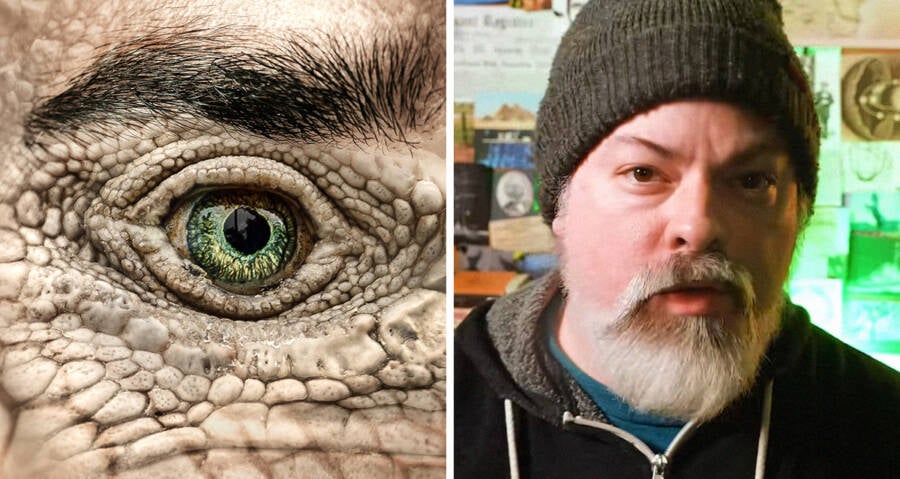
If people populated the Earth before us, would we even know? That’s the question explored by the Silurian Hypothesis — and it opens up some frightening possibilities.

Jeff Foran breaks down the Silurian Hypothesis, which explores whether we would be able to detect if another civilization existed before us.
In the grand scheme of things, human beings haven’t been around for that long. Current estimates are that our Earth was formed about 4.5 billion years ago. Our ancestors only popped up around 6 million years ago, while Homo sapiens themselves have likely been here for just 300,000 years.
As best we can tell, across that entire time, humans are the only animals that have possessed our level of intelligence and capability.
But just how sure are we of that? Is it possible that another civilization existed before us, then faded into a historical record beyond our reach? That’s the question posited by the Silurian Hypothesis.
What Is The Silurian Hypothesis?
In a TikTok video with over 88,000 views, Jeff Foran asks “What if the first civilization wasn’t human?”
“In 2018, two scientists, NASA researcher Gavin Schmidt and astrophysicist Adam Frank, published a peer-reviewed paper asking the question, ‘If an advanced civilization existed millions of years before us, would we even know?’” Foran says. “They called it the ‘Silurian Hypothesis.’”
As noted by Foran, humans and other intelligent life produce a lot of waste. But, over a long enough timespan, that waste eventually simply becomes part of the Earth.
“That’s what makes this idea so unsettling,” Foran states. “The fossil record only preserves a tiny fraction of life that ever existed. So, if a civilization rose, industrialized, and collapsed and vanished deep into prehistory, it might not even leave a trace behind, aside from some faint signal. And would it even look any different from a natural event? And how would we know?”

Leo_Visions UnsplashThe researchers used a “Doctor Who” episode as playful inspiration for the name of the hypothesis. In the episode, the Doctor meets lizard people that predate humanity and are called Silurians.
From here, Foran states that, 56 million years ago, there was a spike in both global CO2 and the Earth’s temperature. This is what scientists refer to as the “Paleocene Eocene Thermal Maximum.” Using this, he implies that there could have been a race of intelligent beings extant around this time.
“Debunkers and skeptics of this theory say that it was a period of extreme volcanism and methane release from the oceans. And that may be the case,” he starts.
“But if there was a species — say a dinosaur-like species — that evolved in advance to our level and beyond and needed to survive some kind of global catastrophe, where would they go?” he continues. “Well, that’s interesting, because a lot of ancient cultures around the world made idols and iconography depicting beings like this and also have legends about them coming from underground or the ocean to influence humanity.”
Foran then references recent UFO disclosures before sarcastically stating, “Better look the other way — because nobody came before us, right? Right.”
Examining The Silurian Hypothesis
To be clear, the Silurian Hypothesis does not claim that there was intelligent life prior to humans. Instead, the hypothesis serves as a thought experiment: If there was intelligent life before us, how would we even know? Is this something we’d even be able to detect?

Rohit Choudhari UnsplashThe Silurian Hypothesis proposes that the buildings of this civilization would likely be undetectable today.
The paper proposing this theory, which can be read in the International Journal of Astrobiology, notes that over time, everything disappears. If a skyscraper were built 100 million years ago, it would be exceedingly unlikely that evidence of it would be detectable today. This means that if we wanted to find evidence of intelligent life hundreds of millions of years ago, we wouldn’t be able to simply look for fossils.
Instead, Schmidt and Frank state that scientists would have to look for other evidence of life, such as emissions. The problem is that there are natural processes that can also produce many of these natural signs of life.
The paper specifically calls out the Paleocene Eocene Thermal Maximum (PETM) mentioned by Foran. This event involved a major release of carbon, global warming, changes to the ocean’s chemistry, extinction of some animals, and shifts in the lives of other animals. On the surface, this does look similar to the impact humans are presently having on the planet.
But, as the paper itself notes, this similarity is not enough to say that the changes were caused by human-like beings. Natural processes can also cause these changes, like volcanic activity, tectonic changes, and more.
It Goes Even Deeper
The paper also proposes a paradox that further complicates matters. In order to last a long time, a civilization would likely have to become more sustainable. However, the more sustainable a civilization is, the less theoretical damage it does to the planet — and the less damage it does, the harder it becomes to detect.
If there was a fossil fuel-burning civilization that ravaged the planet, there’s a chance it would show up in the historical record. A long-lasting civilization rooted in peaceful coexistence with the planet, in contrast, would probably not leave detectable markers on the historical record.
So, Were There Ancient People?
Foran takes the conclusions of this paper and ties them to stories from ancient people, some of whom claimed there were sea people who assisted them in everyday life.
This is a stretch, to say the least. In order for this to be true, a society would have to be driven into the water around 56 million years ago, then last long enough to encounter early humans around 200,000 to 300,000 years ago — then disappear entirely. There’s simply no evidence that this is the case.
Still, the ideas put forth by the Silurian Hypothesis are enough to keep even the most skeptical scientists up at night. At the end of the day, we just can’t be sure if there were human-like creatures hundreds of millions of years ago that were lost to time.
All That’s Interesting reached out to Foran via email.
If you want to shake up your understanding of history even more, take a look at some of the bizarre out-of-time artifacts that have been found across the planet. Then, learn why chicken bones may have our biggest impact on the future archaeological record.