

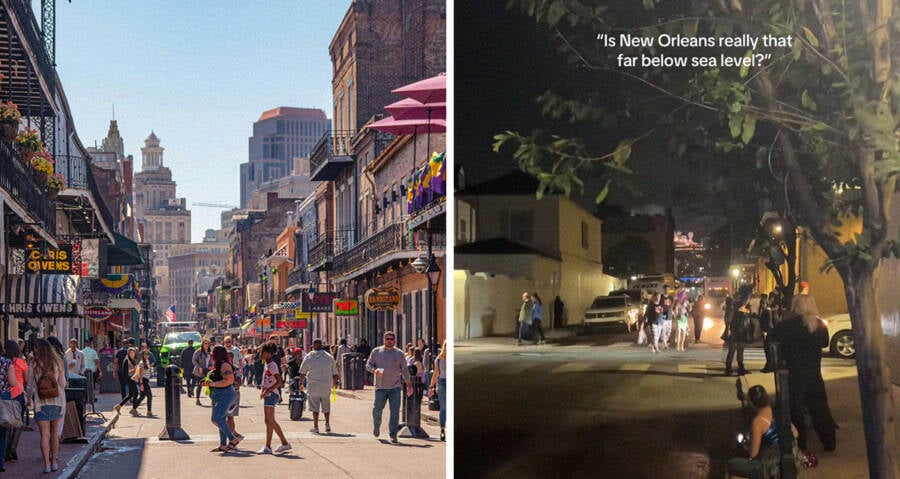
New Orleans is a city known for its cuisine, culture, and natural wonders. It’s also precariously situated below sea level — and now, some are learning just how much that affects this famous city.
Travelers to New Orleans are often impressed by just how many unique features the Big Easy has. Unfortunately, they’re also quickly made aware of how much natural disasters impact the city.
After Hurricane Katrina ripped through New Orleans in August 2005, the city struggled to recover both financially and physically. The city has fewer people and jobs than it did in the year 2000, and many structures hit by the storm are still vacant to this day.
One of the reasons why storms like Katrina are so devastating to the city is because of just how low the city really is. Now, a viral video is demonstrating what that means for residents.
Is New Orleans Really This Low?

Kristina Volgenau/Unsplash, @xchaunxzy/TikTokTikToker @xchaunxzy filmed a cruise ship from the streets of New Orleans. The bottom of the vessel is visible, showing the city is below sea level.
In a video with more than 17 million views, TikTok user @xchaunxzy asks, “Is New Orleans really that far below sea level?”
Her video then shows a cruise ship. Even though the TikToker is on the streets of the city, she can see the bottom of the vessel, showing that the city is significantly below sea level.
“Considering the bottom of this cruise ship, EVEN FROM A DISTANCE, is above us.. I’d say so,” she says, answering her own question.
This is a real phenomenon. As explained by NASA, much of metropolitan New Orleans sits about 1.8 meters (or six feet) below sea level.
This is because the area where the city lies effectively has a bowl shape, with the city itself situated between (and underneath) the Mississippi River and nearby Lake Pontchartrain. While much of the city was previously above sea level, man-made levees and drainage canals inspired development outward, pushing some of the city into swampy, lower-situated land.
Making matters worse were the levees’ impact on natural sediment flows. Prior to the installation of the levees, a natural process of sediment deposits caused the area to remain relatively level. However, once the levees were installed, this process was halted. Consequently, the city began to sink.

@lookatlolly/TikTokMany residents and travelers have noticed that large ships pass the city at what appears to be eye level.
Today, New Orleans residents and visitors are continually reminded about just how low their city really is. Over the years, several similar videos have gone viral, showing large ships passing the city at what appears to be eye level.
Is The City Still Sinking?
In short, yes. According to one 2025 estimate, the city could be sinking by as much as one to two inches every year.
While this may not sound like much, the impact of even minor decreases can be dramatic over time. As reported by the Guardian, a recent study claims that New Orleans has already passed a “point of no return” when it comes to protecting the city from both rising oceans and the sinking, eroding land that surrounds it.

@racheldenae21/TikTokExperts have recommended that the city — which, by some estimates, is sinking one to two inches every year — begin relocation efforts.
There are some moves being made to prevent this from happening.
For example, billions of dollars have been spent strengthening the city’s flood protection systems. That said, other efforts that could have mitigated some of the worst possible issues, such as the proposed Mid-Barataria Sediment Diversion, have been scrapped over cost concerns and other factors.
For the time being, even with the city’s levees, pumps, floodgates, and coastal restoration efforts, New Orleans may be past a point where it can be preserved in its current form. As such, some experts are recommending that relocation efforts begin, where the government implements a measured retreat from the most at-risk areas.
Some may see this and begin planning a trip to New Orleans in order to see it before it disappears. Thankfully, the timeline is not so short that this is a practical concern. Dr. Torbjörn Törnqvist, a geology professor at Tulane University and lead author of the aforementioned study, says he has no plans to leave the city.
Instead, Törnqvist and other researchers are hoping that this information serves as a call to action that something must be done to prevent the worst possibilities from occurring.
All That’s Interesting reached out to @xchaunxzy via email.
To see how extreme weather can impact a city, learn about the devastating hurricane that nearly wiped out Galveston, Texas. For more peculiarly placed cities, check out Nan Madol — an ancient city built on a coral reef.