

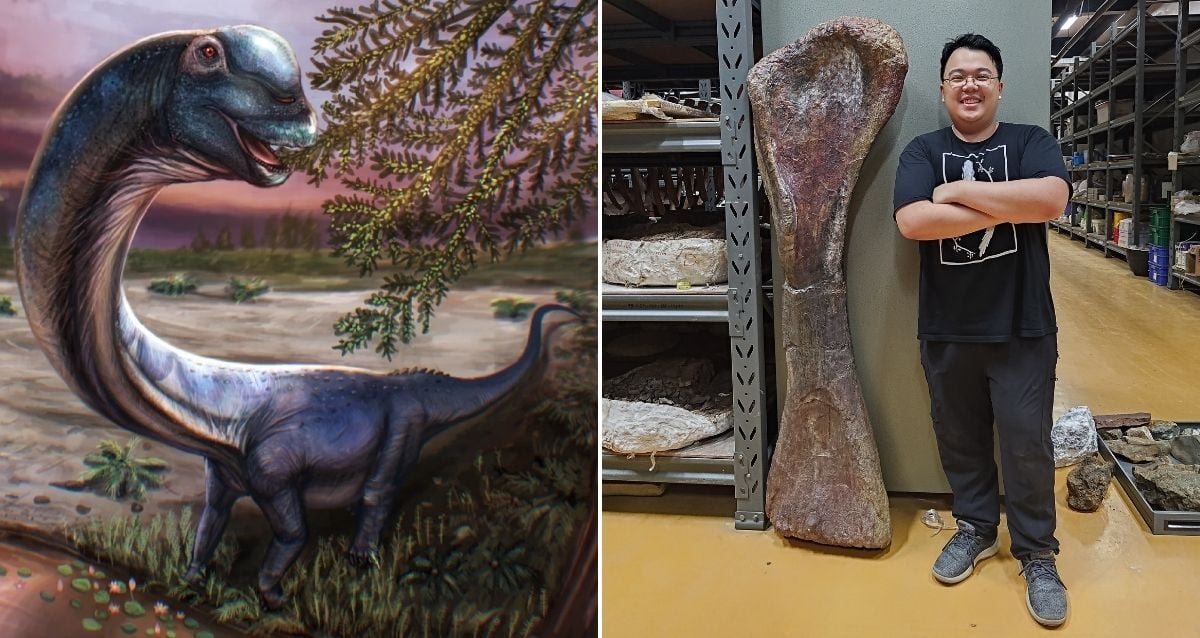
Nagatitan chaiyaphumensis roamed Thailand 113 million years ago — measuring 88 feet long and weighing nearly 30 tons.

Sethapanichsakul et al., Scientific Reports (2026)An artist’s rendition of Nagatitan Chaiyaphumensis, a massive sauropod that lived 113 million years ago.
In 2016, a man named Thanom Luangnan spotted some odd rocks on the shore of a pond in Thailand’s Chaiyaphum Province. Paleontologists excavated the site — and soon realized that Luangnan had discovered the largest dinosaur ever found in Southeast Asia.
The newly-identified species, dubbed Nagatitan chaiyaphumensis, was a long-necked sauropod that roamed Thailand around 113 million years ago. While the dinosaur isn’t the largest known sauropod, its size is revealing how prehistoric changes in climate and vegetation set the stage for even more massive beasts to develop.
The Discovery Of Nagatitan Chaiyaphumensis
As Sita Manitkoon, a paleontologist at Thailand’s Mahasarakham University, told National Geographic, the fossilized remains of Nagatitan chaiyaphumensis were discovered by chance when Thanom Luangnan stumbled upon them in 2016.
“He observed what he described as strange-looking rocks on the banks of a public pond,” said Manitkoon. Luangnan reported his find to the Department of Mineral Resources, and paleontologists soon began excavating the site. The initial dig took place between 2016 and 2019, but it was then delayed until 2024 due to a lack of funding. When scientists finally uncovered the last of the fossils, they were stunned by what they saw.
“Initial measurements of the bones excavated suggested that this could be the largest dinosaur ever found in Southeast Asia,” Manitkoon said.
The colossal prehistoric creature was named after the Naga — a legendary giant serpent from Southeast Asian folklore — and the Titans of Greek mythology, in addition to the region where its remains were unearthed.
While paleontologists didn’t find the full skeleton of Nagatitan chaiyaphumensis, they did unearth enough vertebrae, ribs, and hip and limb bones (one of which was nearly six feet long) to estimate that this sauropod was more than 88 feet long and weighed 30 tons — three times more than a Tyrannosaurus rex.

Thitiwoot Sethapanichsakul/University College LondonLead author Thitiwoot Sethapanichsakul stands next to a replica of the upper front leg bone of Nagatitan.
These findings were recently released in a study published in the journal Scientific Reports. In a statement released by University College London, lead study author Thitiwoot Sethapanichsakul, a Thai doctoral student at the university, explained, “We refer to Nagatitan as ‘the last titan’ of Thailand. That is because it was discovered in Thailand’s youngest dinosaur-bearing rock formation.”
Sethapanichsakul continued, “Younger rocks laid down towards the end of the time of the dinosaurs are unlikely to contain dinosaur remains because the region by then had become a shallow sea. So this may be the last or most recent large sauropod we will find in Southeast Asia.”
At the same time, Nagatitan is revealing more about how exactly dinosaurs grew so large during the Cretaceous Period.
How Prehistoric Environmental Changes Led To Supersized Beasts
As Sethapanichsakul told NPR, “One of the many features that we’re kind of excited about is the size of this dinosaur… It gives us an understanding of the potential kind of evolutionary trends that are beginning to occur.”
The Nagatitan fossils were found in rocks that dated back 113 million years. At that time, Thailand was closer to the equator and likely covered in open, dry shrublands that were conducive to large sauropods, which could easily travel across the land to eat plants.
“Savannah-like ecosystems are known to favor the development of megaherbivore faunas,” Pedro Mocho, a paleontologist at Portugal’s Universidade de Lisboa, told National Geographic, “and it would not be surprising if environmental factors were related to sauropod gigantism.”

Mahasarakham University Thailand/FacebookThitiwoot Sethapanichsakul and Sita Manitkoon examine the bones of Nagatitan.
It’s seemingly counterintuitive that large creatures like Nagatitan could survive in such high temperatures, but their long necks actually provided more surface area through which they could shed heat and cool their bodies. Indeed, even larger sauropods — like Patagotitan mayorum — developed under similar conditions later in the Cretaceous Period.
“In the Middle Cretaceous,” Sethapanichsakul told NPR, “we find dinosaurs in China, South America, and probably Africa that are super giants. They are the biggest of the biggest.” And Nagatitan “essentially represents that kind of on-ramp towards that kind of supersizing.”
While this study has obvious scientific significance, it also marks a key milestone in Sethapanichsakul’s career. “I’ve always been a dinosaur kid,” he said. “This study doesn’t just establish a new species but also fulfills a childhood promise of naming a dinosaur.”
After reading about the discovery of the largest dinosaur ever found in Southeast Asia, learn 31 surprising facts about dinosaurs. Then, step into another moment in Thailand’s history: the 2018 cave rescue.