

Violence has accompanied humanity throughout recorded history, leaving behind countless mysteries that still puzzle archaeologists today. Advances in forensic science, DNA analysis, and modern imaging techniques have solved some ancient crimes. Still, many remain stubbornly unsolved despite decades of research.
From carefully arranged mass graves to murdered kings and frozen victims whose killers were never found, these ancient cold cases continue to challenge historians and remind us that some secrets can survive for thousands of years.
Related: 10 Merciless Monarch Murders You May Not Know About
10 The Koszyce Mass Grave
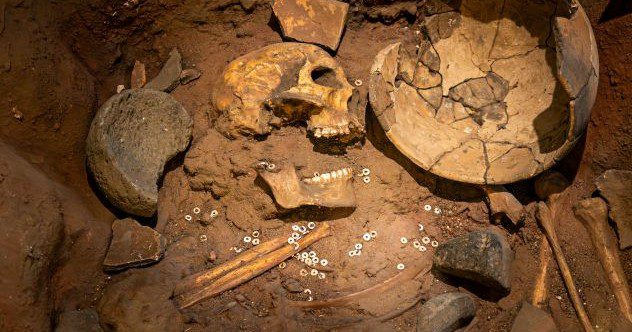
Discovered in the Polish village of Koszyce in 2011, the Koszyce mass grave contains the remains of 15 women, children, and young men who lived about 5,000 years ago. DNA analysis revealed they all belonged to the same extended family spanning three generations of the Globular Amphora culture. Each victim suffered fatal blows to the head. Yet, they were buried with remarkable care, with mothers placed beside their children and siblings laid to rest together.
The orderly burials suggest the victims’ surviving relatives—not their killers—returned later to bury them. Curiously, adult men from the family were absent from the grave, leading archaeologists to suspect they were away when the attack occurred. Researchers believe the massacre may have resulted from conflict between neighboring farming groups competing for land and resources.
One of the most remarkable aspects of the discovery is that genetic testing allowed scientists to reconstruct one of the oldest known family trees from ancient DNA. Even with this unprecedented level of detail, however, the identities of the attackers and the precise motive behind the massacre remain unknown.[1]
9 Clonycavan Man
When workers harvesting peat in Ireland uncovered the remarkably preserved body known as Clonycavan Man in 2003, they found far more than an ordinary bog body. The Iron Age man, who died between 392 and 201 BC, had suffered a series of horrific injuries, including repeated axe blows to the head, a slashed chest, and disembowelment before being deposited in the bog.
Researchers also discovered that his elaborate hairstyle had been stiffened with a plant-based resin imported from southwestern Europe. The expensive hair product suggests Clonycavan Man enjoyed unusually high social status and that long-distance trade networks connected Iron Age Ireland with continental Europe centuries before the Roman conquest.
His violent death has fueled numerous theories. Some scholars believe he was a king ritually sacrificed after failing to protect his people during famine or political turmoil, while others argue he was simply the victim of a brutal murder. Despite decades of study, no one knows who killed him or why.[2]
8 The Prince of Helmsdorf
The richly furnished burial of the so-called Prince of Helmsdorf, discovered in Germany, contained one of Bronze Age Europe’s wealthiest individuals—and one of its oldest suspected murder victims. Dating to roughly 1800 BC, the nobleman was buried with gold ornaments, fine weapons, and other luxury goods reflecting extraordinary status.
Modern CT scans revealed that he died from a deep stab wound to the back, likely inflicted by a bronze dagger. Because he appears to have been attacked from behind, many archaeologists believe he was assassinated rather than killed in open combat. His elite position has even led some historians to describe the case as one of history’s earliest known political assassinations.
Whether he fell victim to palace intrigue, a rival noble, or a broader struggle for power remains impossible to determine. More than 3,800 years later, the identity of his killer remains one of Bronze Age Europe’s oldest unsolved crimes.[3]
7 Grauballe Man
The remarkably preserved Grauballe Man emerged from a Danish peat bog in 1952 looking as though he had died only recently. Radiocarbon dating later showed he actually lived during the Iron Age, around the third century BC. His throat had been cut from ear to ear, almost certainly causing his death.
Modern forensic analysis has largely settled how he died—but not why. His carefully placed body, the absence of defensive wounds, and similarities to other bog bodies have led many researchers to suspect he was sacrificed as part of a religious ritual. Others believe he may have been executed as a criminal or political prisoner before being placed in the bog.
Because no written records survive from the people who buried him, his final moments remain open to interpretation. His haunting expression and extraordinary preservation continue to make Grauballe Man one of Europe’s most compelling ancient murder mysteries.[4]
6 Pharaoh Seqenenre Tao
For generations, historians debated how the Egyptian pharaoh Seqenenre Tao met his end during the Hyksos occupation of northern Egypt around 1555 BC. His badly damaged mummy displayed multiple head wounds, but whether he died in battle, was executed after capture, or fell victim to assassination remained uncertain.
Recent CT scans have provided remarkable new clues. The injuries match several different Hyksos weapons, including battle axes, spears, and daggers, suggesting the pharaoh suffered a coordinated assault rather than a single fatal blow. His hands also appear to have been restrained, leading some researchers to conclude he may have been captured before being executed.
Although the evidence strongly indicates a violent death connected to Egypt’s war of liberation against the Hyksos, historians still cannot reconstruct the exact circumstances. Whether Seqenenre Tao died heroically on the battlefield or was murdered after capture remains one of ancient Egypt’s enduring mysteries.[5]
5 Ötzi the Iceman
When hikers discovered the frozen body of Ötzi high in the Alps in 1991, they initially believed they had found a recently deceased mountaineer. Instead, they uncovered Europe’s oldest known cold case. The remarkably preserved man had died around 3300 BC, and modern forensic analysis has revealed that his final hours were far more violent than anyone first imagined.
CT scans and X-rays showed that Ötzi had been struck in the back by an arrow that severed a major artery, causing him to bleed to death within minutes. He also suffered a deep cut to his hand shortly before his death and a severe blow to the head, suggesting he had been involved in a violent confrontation. His valuable copper axe and other possessions were left behind, making robbery an unlikely motive.
Despite decades of study, investigators still cannot determine exactly who killed Ötzi or why. Was he ambushed while fleeing enemies, murdered over a political dispute, or caught in a personal conflict that turned deadly? More than 5,000 years later, Europe’s oldest homicide investigation remains open.[6]
4 The Sandby Borg Massacre
In the fifth century AD, something horrific happened inside the ring fort of Sandby Borg on the Swedish island of Öland. Archaeologists excavating the settlement uncovered the unburied remains of men, women, and children exactly where they had fallen, suggesting the inhabitants were killed suddenly and left where they died. No evidence indicates anyone returned to bury the victims.
The discovery is even more puzzling because valuable jewelry, coins, and luxury goods remained untouched inside the houses. If robbery motivated the attack, why were so many prized possessions abandoned? Some researchers believe the massacre served as a deliberate warning to neighboring communities, with survivors forbidden from returning to recover either the dead or their belongings.
The identity of the attackers remains unknown, as does the reason the settlement was permanently abandoned. More than 1,500 years later, Sandby Borg stands as one of northern Europe’s most chilling unsolved massacres.[7]
3 The Entrains-sur-Nohain Mass Grave
Near the modern French village of Entrains-sur-Nohain, archaeologists uncovered a mass grave containing more than 20 men, women, and children dating to between the eighth and tenth centuries AD. The victims were buried near the site of the former Roman town of Intaranum. Yet, they appear to have had no connection to the ancient settlement itself.
One theory links the grave to the nearby Battle of Fontenoy-en-Puisaye in AD 841, one of the bloodiest conflicts of the Carolingian Empire. Another suggests the victims may have died during Viking raids that repeatedly devastated communities across France during the ninth century. Archaeologists have ruled out the possibility that the remains belonged to the earlier Roman population based on both radiocarbon dating and the burial context.
Without written records identifying the victims, historians cannot determine who they were, who killed them, or why they were buried together in such unusual circumstances. The grave remains one of medieval Europe’s most intriguing unsolved archaeological mysteries.[8]
2 How Did Cleopatra Die?
Cleopatra VII, the last active ruler of the Ptolemaic Kingdom of Egypt, died on August 12, 30 BC, but the exact circumstances of her death remain surprisingly uncertain. The traditional account holds that, after Mark Antony’s suicide and Octavian’s victory at Actium, Cleopatra took her own life by allowing an Egyptian cobra to bite her.
Many historians, however, question that famous story. The principal account was written decades later by Plutarch, who acknowledged that the details were already disputed in his own time. Other theories suggest Cleopatra may have used a fast-acting poison concealed in a hairpin or ointment rather than a snake, while some scholars have even proposed that Octavian ordered her death to eliminate the possibility of future political resistance.
More than 2,000 years later, no contemporary evidence conclusively explains how Egypt’s last pharaoh died. Whether by suicide, poison, or murder, Cleopatra’s final moments remain one of antiquity’s greatest historical mysteries.[9]
1 The Gallina Genocide
The Gallina culture flourished in what is now northern New Mexico during the twelfth and thirteenth centuries before seemingly vanishing from history. Archaeologists have made a disturbing discovery at nearly every Gallina site they have excavated: skeletons bearing unmistakable signs of violent deaths, including crushed skulls, fractures, and cut marks. Many settlements also show evidence of burning and defensive tower construction, suggesting the people expected conflict before their disappearance.
One particularly significant excavation uncovered the remains of five adults, one child, and one infant in a remote canyon, all showing evidence of brutal attacks. The repeated pattern has led many researchers to conclude that the Gallina were victims of widespread, organized violence rather than isolated incidents.
Who carried out the killings remains unknown. Proposed explanations include warfare fueled by prolonged drought, conflicts with neighboring cultures, or attacks by newly arrived groups moving into the region. Whatever happened, the Gallina’s fate remains one of North America’s oldest and most haunting unsolved murder mysteries.[10]