

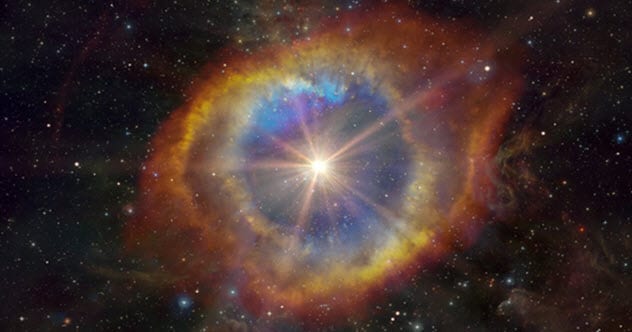
Around a century ago, astronomers believed our Milky Way encompassed the entire universe. Then Henrietta Swan Leavitt’s work on Cepheid variable stars and Edwin Hubble’s observations revealed that the mysterious “nebulae” scattered across the night sky were actually entire galaxies beyond our own. This discovery forever changed humanity’s view of the cosmos.
Today, powerful observatories like the James Webb and Hubble space telescopes are revolutionizing astronomy once again, helping scientists tackle some of space’s biggest mysteries. From newborn planets to speeding stars and the fate of our own galaxy, these discoveries are bringing us closer than ever to explaining the universe’s greatest cosmic conundrums.
Related: 10 Incredible Scenes of Cosmic Violence
10 Mars’s Neon Mystery
Mars contains an unexpectedly large amount of neon—a chemically inert noble gas—in its mantle, hinting that the Red Planet may have remained geologically active far more recently than scientists once believed.
Evidence comes from several sources. NASA’s Viking landers detected neon in the Martian atmosphere during the 1970s, while meteorites blasted from Mars by ancient impacts contain neon isotopes trapped within their minerals. The puzzle is that models suggest Mars should have lost most of its neon within roughly 100 million years.
Some neon arrives aboard comets and asteroids, while additional amounts form when cosmic rays strike the Martian surface. Even so, researchers calculate there’s still too much to account for. The most compelling explanation is that neon continues to escape from Mars’s interior, reinforcing other evidence that volcanic activity may have occurred as recently as 50,000 years ago—a mere blink of an eye on geological timescales.[1]
9 The Fast-Forward Universe
The James Webb Space Telescope continues to surprise astronomers by revealing that the early universe matured much faster than existing models predicted.
Among Webb’s most remarkable discoveries is Zhúlóng, which may be the most distant spiral galaxy ever observed. Despite existing just one billion years after the Big Bang—when the universe was only about 7% of its current age—the galaxy already possessed a central bulge, a well-defined star-forming disk, and elegant spiral arms. Such mature structures were once thought to require billions of years to develop.
Zhúlóng was discovered during one of Webb’s “pure parallel surveys,” in which the telescope photographs seemingly random portions of the sky while carrying out unrelated observations. The finding highlights both Webb’s extraordinary sensitivity and the possibility that astronomers may need to rethink how quickly galaxies formed during the universe’s earliest epochs.[2]
8 Stars Are Like Onions
Stars really are layered like onions. Their outer shells contain lighter elements such as hydrogen and helium, while progressively heavier elements accumulate toward the core.
Astronomers recently observed a never-before-seen type of supernova, SN2021yfj, that contained unexpectedly strong signatures of silicon, sulfur, and argon—elements normally buried deep inside a massive star. Because those heavier layers became visible, scientists concluded the star had already been stripped almost to its core before exploding.
Even after losing much of its outer structure, the dying star still produced an extraordinarily bright explosion visible from some 2.2 billion light-years away. The discovery provides astronomers with an unprecedented glimpse into the hidden internal layers of massive stars just before they die.[3]
7 How Solar Systems Are Born
One of the James Webb Space Telescope’s most stunning images offers an extraordinary glimpse of a solar system in its infancy.
The young protostar IRAS 04302+2247 lies about 525 light-years away within a dense molecular cloud. Surrounding it is a protoplanetary disk several times larger than our own solar system, where grains of dust are gradually clumping together into future planets. Webb’s infrared instruments can peer through the surrounding dust, revealing these earliest stages of planetary formation with unprecedented clarity.
The spectacular butterfly-shaped clouds surrounding the star are reflection nebulae—vast sheets of dust and gas illuminated by the newborn star itself. Together, the observations provide astronomers with one of the clearest views yet of how planetary systems like our own first take shape.[4]
6 A Five-Planet Family
Astronomers have identified a fifth potentially habitable planet orbiting the nearby red dwarf L 98-59, creating one of the most intriguing compact planetary systems yet discovered.
Located just 35 light-years away, the system contains several worlds with dramatically different characteristics despite orbiting remarkably close to their small parent star. The innermost planet is only about half Earth’s mass, making it unusually difficult to detect. Two of the inner planets may experience intense volcanic activity caused by gravitational interactions, while another appears to be a possible water world unlike anything in our own solar system.
The newest discovery, L 98-59 f, is especially exciting because it receives roughly the same amount of stellar energy from its red dwarf as Earth receives from the Sun. That places it within the star’s habitable zone, where liquid water—and potentially the conditions necessary for life—could exist.[5]
5 The Perfect Einstein Ring
The European Space Agency’s Euclid space telescope was designed to investigate the universe’s greatest mysteries, including dark matter and dark energy. Along the way, it captured one of the most striking examples of gravitational lensing ever observed: an exceptionally rare Einstein ring.
Einstein’s theory of general relativity predicts that massive objects bend spacetime, causing light traveling behind them to curve as well. When a distant galaxy, a massive foreground galaxy, and Earth align almost perfectly, that warped light forms a luminous ring around the nearer galaxy.
In this remarkable case, the foreground galaxy sits about 590 million light-years from Earth. In comparison, the background galaxy lies some 4.4 billion light-years away. The near-perfect alignment provides astronomers with a naturally magnified view of the distant universe while offering another spectacular confirmation of Einstein’s century-old theory.[6]
4 Baby Planets Compete
Baby sharks aren’t the only youngsters that compete for resources. According to new observations from the James Webb Space Telescope, young planets forming around the star PDS 70 appear to be competing with both one another and their parent star for the material needed to grow.
The five-million-year-old star is surrounded by a vast protoplanetary disk, where gas and dust are gradually assembling into planets. Using Webb’s Aperture Masking Interferometry mode to suppress the star’s glare, astronomers obtained one of their clearest views yet of this cosmic nursery. The observations support the theory that planets grow by accreting surrounding material and suggest the two known planets possess their own circumplanetary disks, where future moons may eventually form.
Even more intriguing is a faint source of light within the disk gap that could represent a spiral arm—or perhaps an entirely new planet still in the process of forming. The resulting image offers one of the closest glimpses scientists have ever had of what our own solar system may have looked like billions of years ago.[7]
3 A Galactic Collision—Maybe Not
For decades, astronomers have confidently predicted that the Milky Way and the neighboring Andromeda Galaxy were destined to collide in roughly 4.5 billion years. New research suggests that this dramatic future is no longer a certainty.
Using observations from the Hubble and Gaia space telescopes, researchers ran 100,000 computer simulations of the galaxies’ future motions. The results indicate only about a 50% chance the two galaxies will merge within the next 10 billion years—and just a 2% chance the collision will occur within the previously accepted four-to-five-billion-year timeframe.
The difference may come down to gravity’s subtle tug-of-war. While Andromeda’s satellite galaxy, M33, nudges the two giants closer together, the Milky Way’s own companion, the Large Magellanic Cloud, pulls our galaxy in the opposite direction. Instead of an inevitable cosmic crash, the two galaxies may spend billions of years locked in a slow gravitational dance.[8]
2 The Sun’s Final Days
The Hubble Space Telescope has captured a breathtaking preview of our Sun’s distant future in the glowing remains of Kohoutek 4-55, a planetary nebula located about 4,600 light-years away in the constellation Cygnus.
Despite the name, planetary nebulae have nothing to do with planets. They form when Sun-like stars exhaust their nuclear fuel and swell into red giants, shedding their outer layers into space. Those expanding shells become illuminated by intense ultraviolet radiation from the exposed stellar core, creating spectacular glowing clouds before the core ultimately cools into a white dwarf.
This brilliant display lasts only tens of thousands of years—a fleeting instant in the roughly 10-billion-year lifetime of a Sun-like star. Someday, billions of years from now, our own Sun is expected to leave behind a similar celestial masterpiece.[9]
1 The Fastest Planetary System
Astronomers may have discovered the fastest planetary system ever observed: a small star and its giant planet racing through the Milky Way at nearly 1.2 million miles (1.9 million km) per hour.
If confirmed, the system would also mark the first known planet orbiting a hypervelocity star. The planet appears to be a super-Neptune—roughly 30 times more massive than Earth—orbiting surprisingly close to its tiny parent star, which possesses only about 20% of the Sun’s mass. Even at that distance, however, the faint star cannot provide enough warmth to place the planet within its habitable zone.
The remarkable system currently lies about 24,000 light-years from Earth. Still, its tremendous speed could eventually propel it completely out of the Milky Way. If so, this extraordinary star and its lone planet may one day become wanderers in the vast emptiness between galaxies.[10]