

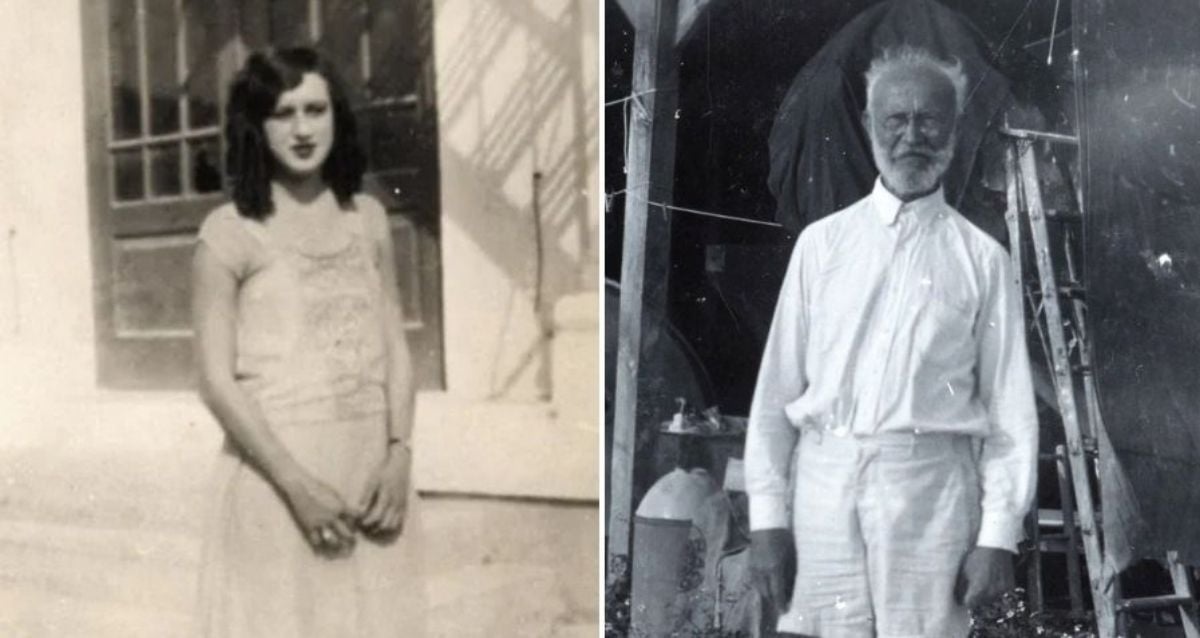
After her death from tuberculosis in 1931, Maria Elena Milagro de Hoyos’ body was taken from her tomb by Carl Tanzler, who covered her decaying flesh with silk and wax and slept next to her body for the next seven years.

Florida Keys History Center/FlickrMaria Elena Milagro de Hoyos was known as a Key West beauty before she died of tuberculosis at age 22.
Maria Elena Milagro de Hoyos was a Cuban-American beauty who lived in Key West in the 1920s. When she was 21, her life took a tragic turn: She was diagnosed with tuberculosis.
During her treatment, Elena met a radiology technician named Carl Tanzler. He became obsessed with her, showered her with gifts, and attempted to prolong her life with a wide variety of remedies.
Despite these efforts, Elena passed away in October 1931 at age 22. But death couldn’t put a damper on Tanzler’s affections. He had an elaborate mausoleum built for Elena and serenaded her grave every evening. Still, it wasn’t enough for him.
After months of these nightly visits, Carl Tanzler exhumed the corpse of Maria Elena Milagro de Hoyos and attempted to “resurrect” her with silk, wax, piano wire, and perfume. Then, he slept beside her — for the next seven years.
The Early Life Of Maria Elena Milagro De Hoyos
Maria Elena Milagro de Hoyos was born in Key West in 1909 to Aurora Milagro and Francisco “Pancho” Hoyos, a cigar maker. She had an older sister, Nana, and a younger sister, Celia. According to Ben Harrison’s book Undying Love: The True Story of a Passion That Defied Death, Elena was known for her beauty, and a friend once described her as “full of life.”
In February 1926, she married Luis Mesa, but their newlywed bliss didn’t last long. During their first year of marriage, Elena had a miscarriage, and Luis left her for another woman soon after. He moved to Miami, though the two never officially divorced.

Florida Keys History Center/FlickrMaria Elena Milagro de Hoyos in 1926.
When Elena fell ill in the late 1920s, her family assumed that she was still grieving from losing both her child and her husband. But when her health continued to deteriorate, they feared the worst. Tuberculosis was spreading through the city, and a visit to the doctor confirmed that Elena had fallen victim to the vicious disease.
At the time, tuberculosis was essentially a death sentence. The first truly effective medications were still more than a decade away — and Maria Elena Milagro de Hoyos didn’t have that much time.
Still, she underwent the treatments that were available at the city’s Marine Hospital. And it was there that she met a radiology technician named Carl Tanzler in April 1930.
Carl Tanzler, The Eccentric ‘Count Von Cosel’
Carl Tanzler was born in Germany in 1877. He wasn’t actually a count, but he’d had dreams as a child of a long-dead ancestor named Countess Anna Constantia von Cosel, so he later adopted the title. The countess had allegedly shown him the face of his true love — and he was shocked when he walked into Maria Elena Milagro de Hoyos’ room to take a blood sample and saw the woman from those visions staring back at him.

Florida Keys History Center/FlickrCarl Tanzler, the German radiology technician who lived with the corpse of Maria Elena Milagro de Hoyos for seven years.
Tanzler was a married man himself. He’d immigrated to the United States with his wife and two children in the 1920s, but he wasn’t going to let that interfere with fate. Besides, his family was living in Zephyrhills, Florida, nearly 300 miles away. Nothing could stand in his way. Nothing, that is, except for tuberculosis.
Although Tanzler was more than 30 years older than Elena, he fell madly in love with her. There is no evidence that she returned his affections, but he still showered her with gifts and brought medical equipment to her home in an attempt to treat her.
Of course, this was useless, and Maria Elena Milagro de Hoyos died on Oct. 25, 1931, at age 22. To the astonishment of Elena’s family, Tanzler commissioned an opulent mausoleum in Key West Cemetery for her remains. After her body was placed inside, Tanzler visited the tomb almost every night, serenading her corpse and dreaming of what could have been.

Florida Keys History Center/FlickrThe mausoleum in Key West Cemetery that Carl Tanzler had built for Maria Elena Milagro de Hoyos.
Then, some 18 months after Elena’s death, Tanzler was in the cemetery one evening when he thought he heard a tapping noise coming from the mausoleum. As he recalled in his memoir, The Secret of Elena’s Tomb, he placed his ear against the door and heard Elena’s voice saying, “I wish you would take me with you to your home. I want to stay with you.”
So, in April 1933, Tanzler brought a toy wagon to the cemetery, exhumed Elena’s corpse, and dragged her off. He was determined to be with her — dead or alive.
The Chilling Fate Of Maria Elena Milagro De Hoyos’ Corpse
Carl Tanzler brought Elena’s body back to his makeshift laboratory. There, he opened her coffin for the first time in well over a year.

Florida Keys History Center/FlickrCarl Tanzler often lived with Elena’s corpse on a wingless airplane that he dubbed “Elena’s Airship.”
“I looked into the deep fallen cavities of the eyes, like deep, empty black holes, I saw her dried up lips, slightly parted with her white teeth gleaming between them,” Tanzler wrote. “By further examination I was not surprised to discover small maggots of the gnat-larvae type which were feeding on blood around her head and ears and on the surface of the abdomen.”
To “resurrect” Elena, Tanzler filled her sunken abdominal cavity with sterile packing, pumped her corpse full of fluids, washed her with fragrant soap and cologne, and laid oiled silk coated with beeswax over her skin to preserve it. “She looked as beautiful as ever,” Tanzler said, “and it looked like her own skin.”
Then, Carl Tanzler began living with the corpse of Maria Elena Milagro de Hoyos. He wrote in his memoir:
“Often I kissed her rosy lips… I dressed her in silken garments again, with her bridal dress and veils and the crown of gold and adorned her with all her jewels and white gloves. I kept her thus, lying in state in her large bed, with flowers about her head… To guard her day and night I slept right along side of her.”
This continued for seven years. Then, in 1940, someone purportedly spotted Tanzler dancing with Elena’s corpse through an open window. Word spread quickly, and Elena’s sister Nana ordered Tanzler to open her mausoleum, as he had the only key. Elena wasn’t inside.
On Oct. 5, the police confiscated the body of Maria Elena Milagro de Hoyos from Tanzler’s home. He was accused of “wantonly and maliciously destroying a grave and removing a body without authorization.” However, the statute of limitations on the crime had expired, so Tanzler was never convicted.

Florida Keys History Center/FlickrElena’s corpse on display at a Key West funeral home in 1940.
Elena, meanwhile, was put on display for curious onlookers. Her story had made headlines across the nation, and some 7,000 people filed by over the course of several days to catch a glimpse of her mutilated corpse.
In later years, two physicians who were present at the autopsy of Elena’s remains stated that Tanzler had inserted a tube into her vagina to engage in necrophilia, but no true evidence has ever emerged to support their claims.
Today, Maria Elena Milagro de Hoyos lies at rest once more — this time in an undisclosed location.
After learning about the disturbing story of Maria Elena Milagro de Hoyos, read about Anatoly Moskvin, the Russian grave robber who stole female corpses and dressed them up like dolls. Then, go inside the stories of Carl Tanzler and nine more of the world’s weirdest people.