
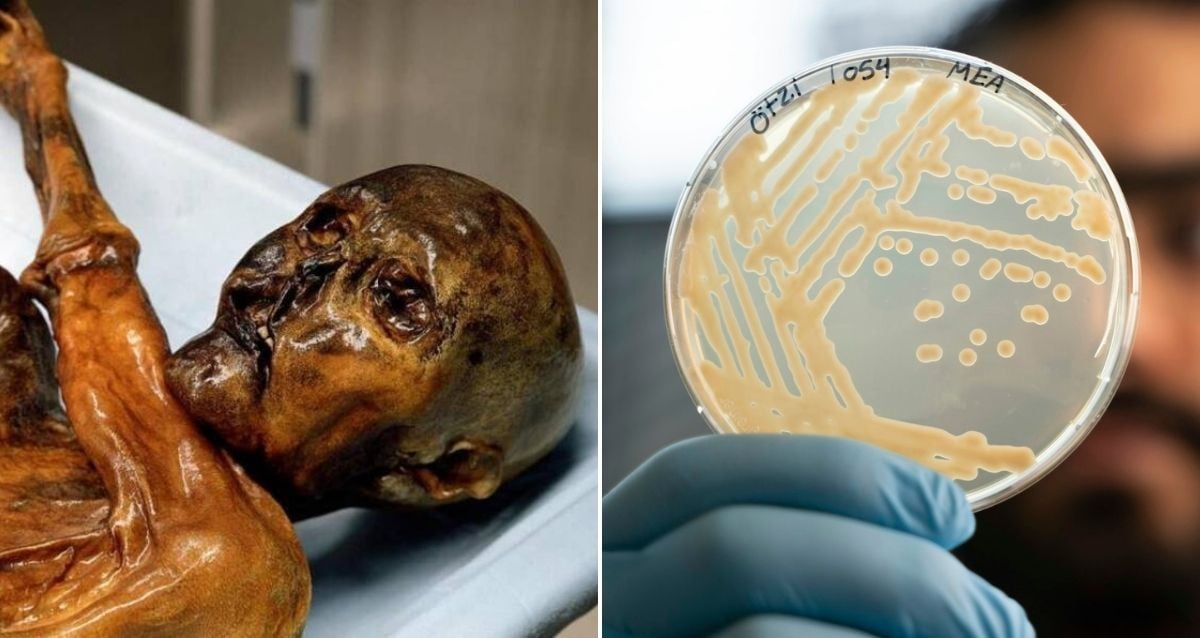
Researchers were able to collect four strains of yeast that had colonized the skin and guts of Ötzi the Iceman, the naturally preserved corpse of a man who was murdered in the frozen reaches of the Alps circa 3200 B.C.E.

South Tyrol Museum of ArchaeologyA trove of prehistoric microbes have been found in the mummified body of Ötzi the Iceman.
Ötzi the Iceman may have died 5,300 years ago, but the mummy is still bringing forth new life today. A recent study of the microbes in and on Ötzi’s body discovered four strains of yeast that scientists believe have been part of his corpse for millennia.
They were able to cultivate the yeast — and they even made “very good” sourdough bread with it. What’s more, the study of Ötzi’s microbiome is providing rare insight into the diets of people who lived during the Copper Age.
Discovering Yeast In Ötzi The Iceman’s 5,300-Year-Old Corpse
The body of Ötzi the Iceman was discovered by two German hikers in northern Italy’s Ötzal Alps in 1991. The mummified corpse had been frozen in a glacier for more than 5,000 years, and it was remarkably well preserved.
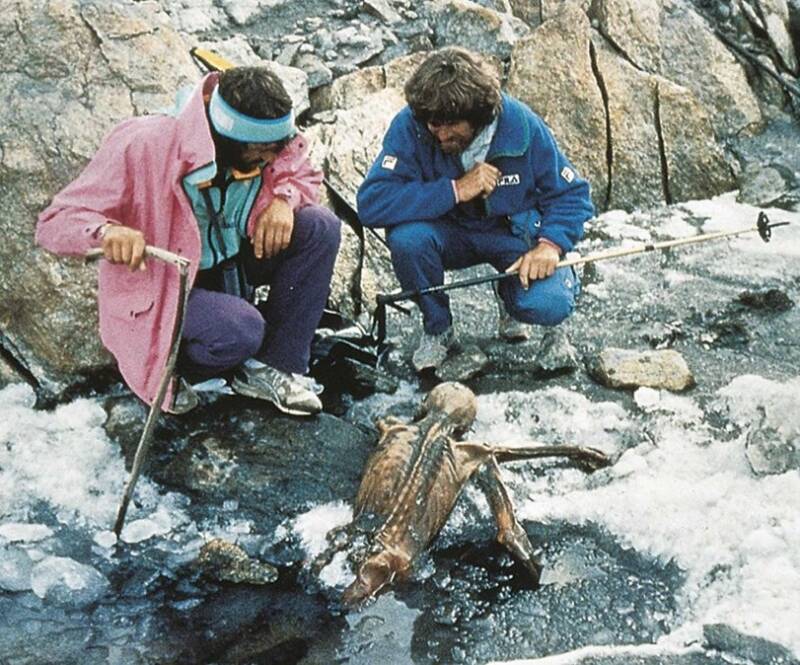
Getty ImagesTwo German hikers observe Ötzi in the glacier where they found him before he could be removed.
Scientists have been studying Ötzi ever since. They’ve determined that he was in his 40s when he died around 3230 B.C.E. — and he was seemingly murdered by someone who shot him in the back with an arrow.
In 2019, a team from Eurac Research Institute for Mummy Studies began analyzing Ötzi’s microbiome, swabbing his skin and glacial water that had melted inside his body over the years. They identified various types of bacteria, but one discovery surprised them: “What we didn’t expect to find was yeast,” lead study author Mohamed Sarhan told the Agence France-Presse (AFP).
The scientists discovered at least four different strains of yeast that have adapted to survive in cold environments, like the refrigerator where Ötzi is kept. Some of these strains are typically found in frigid areas like Antarctica, so researchers believe that they came from the glacier where Ötzi was found, entered his body shortly after his death, and have lived within him ever since.

Eurac Research InstituteThe yeast cultivated from Ötzi’s corpse.
“We see continuity here,” study co-author Frank Maixner said in a statement released by the Eurac Research Institute. “These yeasts have accompanied Ötzi on his long journey through the millennia.”
This discovery also raised unexpected questions. “If you tell anyone you have yeast,” Sarhan told the AFP, “they immediately ask: can we use it for bread?”
So, the scientists decided to find out. “We tried to make a sourdough starter with it,” Sarhan explained in the Eurac statement. “At first, the yeast hadn’t yet adapted to the flour environment, so nothing happened at all… Eventually, we obtained a completely normal dough that rose within 24 hours — basically just like ordinary yeast. We made some really good dough with it.”
The researchers then transformed Ötzi the Iceman’s yeast into sourdough bread. “I’ve never baked bread before,” said Sarhan, “and it showed. So the result definitely had room for improvement.”
Next, they hope to make beer from the prehistoric microbes. But in the meantime, the results of their study — recently published in the journal Microbiome — are contributing to research in other areas.
The Implications Of This Microbial Analysis Of Ötzi
To preserve Ötzi’s body over the decades, scientists have applied a chemical called phenol to stop fungus from growing. However, three of the yeast strains found in Ötzi’s body have seemingly been eating the phenol.
This discovery has implications for far-flung fields: This specific yeast could potentially be used in the future to break down highly toxic phenol after lab accidents or environmental spills.

Eurac Research InstituteMohamed Sahran studies the microbes from Ötzi the Iceman.
What’s more, an analysis of Ötzi the Iceman’s gut microbiome revealed similarities to the guts of modern humans who live in remote societies, like the Hadza people of Tanzania and tribes in northern Madagascar. This suggests that their diets were fairly similar.
A previous study found that Ötzi’s last meal consisted of ibex, deer, and an ancient wheat called einkorn. Like today’s non-Westernized cultures, he ate more fiber and whole grains than people in industrialized civilizations. Knowing what Copper Age humans consumed tells scientists how prehistoric people fueled themselves and provides insight into how our diets have changed over time.
Together, researchers say, these discoveries reveal that Ötzi the Iceman “is not a biologically ‘frozen’ time-capsule but rather a complex ecosystem.”
After reading about the yeast found in the body of Ötzi the Iceman, learn the stories of nine of history’s most chilling mummies. Then, discover how Ötzi the Iceman helped researchers learn new information about HPV.