

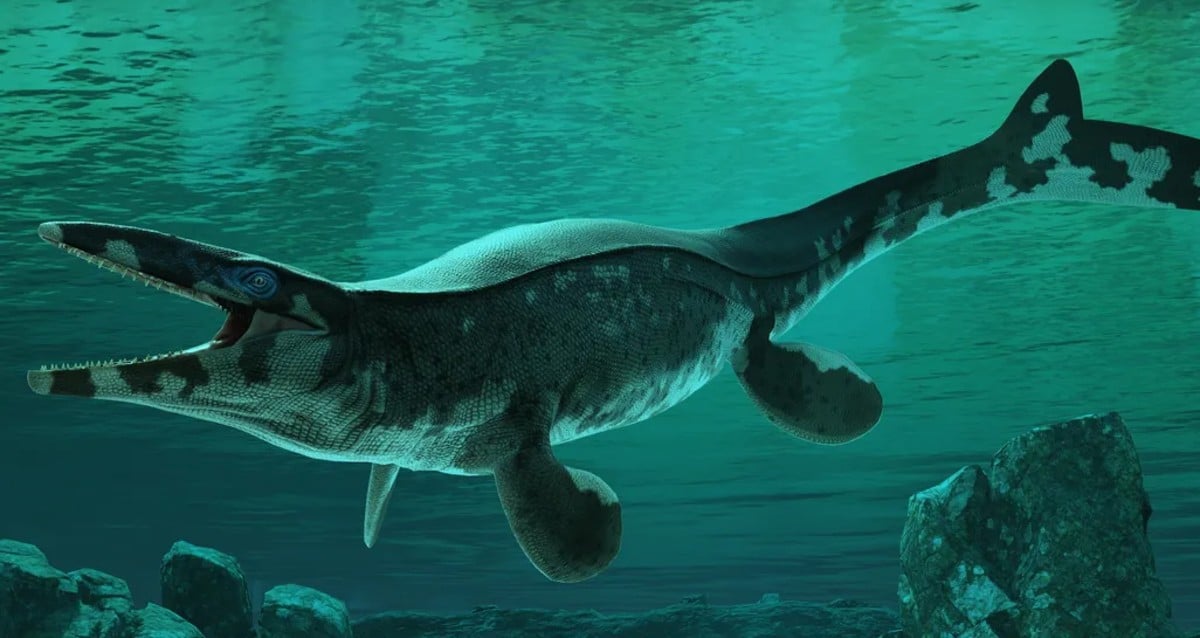
Twice the length of today’s largest great white sharks, Tylosaurus rex could reach up to 43 feet long — making it even bigger than Tyrannosaurus rex.

Alderon Games-Path of TitansA depiction of Tylosaurus Rex, the “T. rex of the ocean.”
As most people know, Tyrannosaurus rex was perhaps the most fearsome dinosaur to walk the prehistoric Earth. But T. rex’s reign of terror was of course limited to land. Now, a group of paleontologists have just identified a new species of aquatic reptile, Tylosaurus rex, that they’re calling the “T. rex of the ocean.”
A massive species of mosasaur, Tylosaurus rex was a powerful and aggressive predator who ruled the seas some 80 million years ago.
How Tylosaurus Rex Was Identified By Paleontologists
To date, multiple fossils of the Tylosaurus rex have been found. But as a recent study published in the Bulletin of the American Museum of Natural History explains, these were long grouped together with another species of mosasaur, T. proriger. It wasn’t until paleontologists took another look at the samples that they realized they had a different species on their hands.

Perot Museum of Nature and Science/American Museum of Natural HistoryA Tylosaurus rex fossil on display at the Perot Museum.
According to a statement from Southern Methodist University, which collaborated on the study alongside the American Museum of Natural History and the Perot Museum of Nature and Science, the disparity between T. proriger and T. rex was first noticed by the study’s lead author Amelia Zietlow. While working with a set of fossils, she noticed a mosasaur that seemed to be misidentified as T. proriger. This fossil was larger than the others and had “finely serrated teeth.”
What’s more, paleontologists realized that a group of similarly oversized fossils had been found in Texas, whereas most of the T. proriger specimens had been found in Kansas. This Texas set was also younger than the Kansas fossils by about 4 million years.
In fact, these researchers were not the first to notice the unusually-sized Texas fossils. Paleontologist John Thurmond had also suggested in the 1960s that these oddly large mosasaur fossils could in fact come from a new species, and so he nicknamed it “Tylosaurus thalassotyrannus,” or “sea tyrant.”

Perot Museum of Nature and ScienceLead study author Amelia Zietlow with the Tylosaurus rex fossil.
“Everything is bigger in Texas and that includes the mosasaurs, apparently,” Zietlow remarked in the statement.
Indeed, the newly-discovered species — known as Tylosaurus rex, “king of the Tylosaurs,” or simply T. rex — could grow up to 43 feet long. Some 80 million years ago, it would have used its imposing size to terrorize the prehistoric oceans.
Tylosaurus Rex’s Reign Of Terror In The Seas Of Prehistoric Earth
The Tylosaurus rex was not just large. It was powerful and aggressive, with sharp teeth and strong jaw and neck muscles that would have made it one of the most fearsome predators in Earth’s prehistoric oceans.
But while Tylosaurus rex would have targeted fish, turtles, and long-necked marine reptiles known as plesiosaurs, paleontologists also believe that its aggressive tendencies could sometimes be directed at its own species.
One T. rex fossil, known as the “Black Knight,” has a fractured lower jaw and is missing part of its snout. Paleontologists believe that this is evidence of an attack — from a fellow T. rex.

Alderon Games-Path of TitansThe Tylosaurus rex could grow up to 43 feet long, or roughly as large as a school bus.
“Besides being huge, roughly twice the length of the largest great white sharks, T. rex appeared to be a much meaner animal than other mosasaurs,” said study co-author Ron Tykoski of the Perot Museum. “Through our study and examination of well-preserved fossils collected throughout the north Texas region, we have evidence of violence within this species to a degree not previously seen in other Tylosaurus specimens.”
Though it’s been extinct for millions of years, the T. rex of the ocean seems to have been just as terrifying as the T. rex on land. Monstrous in size, powerful, and aggressive, with a strong jaw and teeth, Tylosaurus rex likely dominated the Cretaceous seas.
Despite this, the species went undiscovered until recently, which goes to show how much there is still to learn about the prehistoric world.
After reading about the newly discovered species known as the T. rex of the ocean, discover the stories of some of Earth’s most fascinating prehistoric animals. Then, learn about the Terror Bird, the fearsome prehistoric predator that went extinct some 65 million years ago.