

Just 45 minutes after arriving at a California hospital on February 19, 1994, Gloria Ramirez was pronounced dead — but strange fumes from her body made 23 medical staff sick.

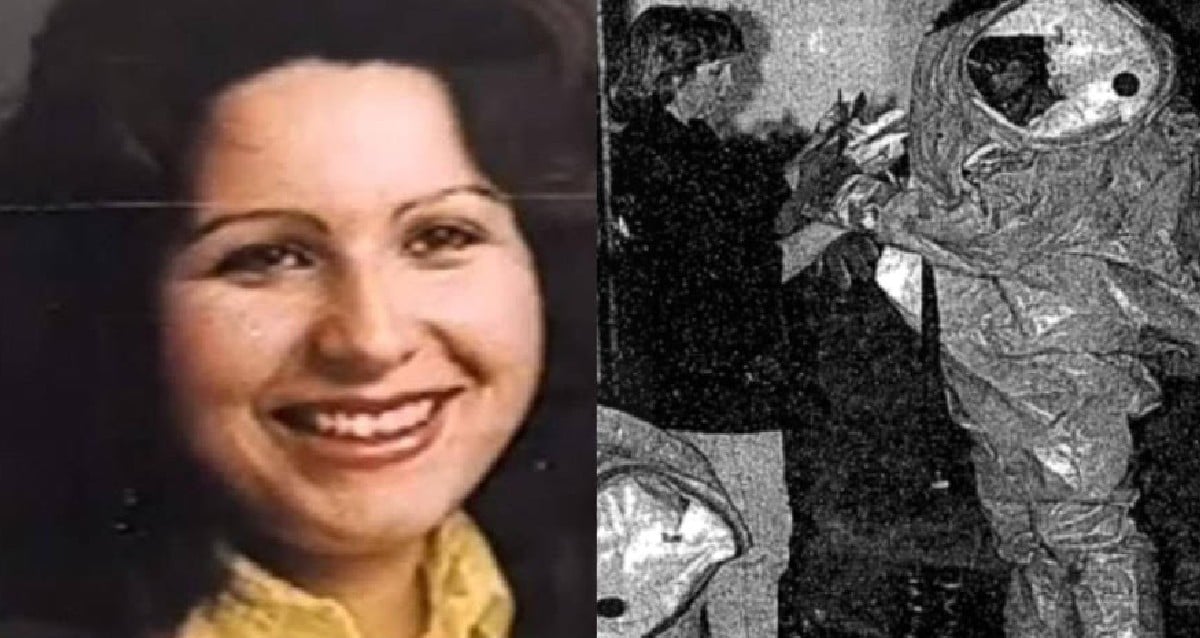
YouTubeKnown as the “Toxic Lady,” Gloria Ramirez emitted strange fumes that left her doctors ill.
Until 1994, Gloria Ramirez was an ordinary woman living in Riverside, California, with her boyfriend and two children. But on February 19, the 31-year-old started having trouble breathing.
Ramirez knew she was sick: she had cervical cancer. She was rushed to Riverside General Hospital, where doctors got to work to try to save her life. Within minutes, however, the medical staff started to feel ill themselves.
By the end of the night, Ramirez died from complications related to her cancer. And dozens of the medical staff who had treated her suffered from a myriad of unexplained symptoms. In the years since, Ramirez has become known as the “Toxic Lady” — but no one knows what made her so toxic.
While many theories have been floated, the reason behind Gloria Ramirez’s “toxicity” remains a mystery to this day.
How Gloria Ramirez Died — And Made Her Doctors Mysteriously Ill
On the night of Feb. 19, 1994, Gloria Ramirez began to feel ill. Her heart was beating fast, she had trouble breathing, and she had been suffering from nausea and vomiting. Ramirez was young, just 31 years old, but had been recently diagnosed with advanced cervical cancer.
Ramirez was rushed to Riverside General Hospital where doctors quickly began to treat her. As Discover Magazine reported in 1995, Ramirez was given a number of drugs as doctors attempted to resuscitate her with an Ambu-bag. When this didn’t work, they prepared to defibrillate her heart.

Riverside University Health SystemThe hospital where Gloria Rivera was treated has since changed locations. This is its location today.
But as the medical staff removed Ramirez’s shirt, they noticed a strange oily sheen on her body, and some people smelled a garlicky odor coming from her mouth.
As a nurse named Susan Kane pulled blood from Ramirez’s arm, she noticed that the blood had a “chemical” smell. What’s more, several medical staff who handled the blood sample also thought it smelled like “ammonia” and noticed that it contained strange particles.
Then Kane fainted.
She was the first of the medical staff treating Ramirez to suffer from a strange symptom, but not the last. Others then fainted, vomited, had trouble breathing, or felt a burning sensation on their skin. One passed out, and when she was awoke, she was unable to control her limbs.
Overall, 23 of the 37 emergency room staff at Riverside General Hospital suffered from at least one symptom. While some of these symptoms cleared up overnight, others lingered into the following weeks.
Meanwhile, Gloria Ramirez tragically died that night. But the investigation into her death had just begun.
The Investigation Into The Death Of The ‘Toxic Lady’
After Gloria Ramirez died, a hazmat team arrived at the hospital to collect her body. They also searched the emergency room for any toxic chemicals, but found none.
Next, the Riverside Coroner’s Office was tasked with determining Rivera’s cause of death. But given the lack of answers about her condition, this was a delicate task. Rivera’s body was placed in a sealed aluminum casket, and the coroners had to conduct their autopsy wearing airtight suits. The coroner’s office also reached out to the Forensic Science Center, at the Lawrence Livermore National Laboratory, for additional help.

New York Times ArchivesCoroners needed to wear hazmat suits in order to conduct Gloria Ramirez’s autopsy.
“We’re dealing with the unknown,” Dan Cupido, the chief deputy coroner for Riverside County, told The New York Times, “and fear of the unknown.”
But the autopsy offered some answers. It revealed the presence of a number of drugs in Rivera’s system: Tylenol, lidocaine, codeine, and Tigan, an anti-nausea medication, which may have caused the ammonia-like smell that some doctors noticed as it broke down. It also revealed that Ramirez had unusually large amounts of dimethyl sulfone in her system.
In the end, the coroner announced that Gloria Ramirez had died from cardiac dysrhythmia, which had been triggered by kidney failure related to her cancer. But no one knew why her doctors had gotten sick too.
Why Did Gloria Ramirez Make Everyone Around Her Sick?
What caused Gloria Ramirez to become so toxic? Her family, outraged that Ramirez had been dubbed the “Toxic Lady,” argued that the hospital could be to blame. Indeed, as the Washington Post reported in 1994, the hospital had had ventilation problems. In 1991, there was a possible leak from hazardous gas. In 1992, an inspector found algae growing in the hospital’s water reservoir. And in 1993, “sewer gas” had seeped into the emergency room.
“I honestly believe my sister may have lived if she hadn’t gone into that emergency room that night,” Ramirez’s sister stated. “I don’t know what [the county] is afraid of, but we want answers.”
There is no evidence that the hospital itself was toxic. But some have suggested that the problem stemmed from the hospital staff, who could have been struck by a case of mass hysteria. But the staff denies this.
It wasn’t until the Forensic Science Center took a second look at Ramirez’s case that a new possibility emerged. They postulated that the dimethyl sulfone found in Ramirez’s system could have come from her possible use of dimethyl sulfoxide, also known as DMSO. DMSO was once seen as a wonder drug, and though the FDA has issued warnings against using it to self-medicate, many people continue to use it to treat their ailments.

FDA/FlickrDMSO cream in its somewhat diluted and less-poisonous form.
Possibly, Ramirez had used a DMSO gel, which would have given her skin its oily sheen and produced the garlicky odor that the medical staff had observed. It may have also caused her toxicity: If you add one oxygen atom to dimethyl sulfoxide, you get dimethyl sulfone, which is what was found in Ramirez’s system. But if you add two, you get dimethyl sulfate, which is highly toxic and has been tested as a nerve gas.
As a gas, dimethyl sulfate vapors destroy cells in people’s eyes, lungs, and mouth. When this vapor gets into the body, it can cause convulsions, delirium, and paralysis. And of the 20 symptoms described by medical staff that night, 19 of them match symptoms of people who have exposure to dimethyl sulfate vapors.
Thus, it’s very possible that Ramirez had used DMSO gel to treat her cancer, which, in turn, had been converted to dimethyl sulfate by the oxygen given to her by paramedics. Now a toxin, it had sickened her doctors.
However, Ramirez’s family denied that she used DMSO. And the DMSO theory simply stands as that — a theory.
Indeed, no one is entirely sure what happened to Gloria Ramirez. But she deserves to be remembered as more than the “Toxic Lady.”
At her funeral, as reported by the Los Angeles Times, she was eulogized instead as warm person, a friend who was always quick with a smile or a joke. She deserved to be remembered for that and not, as her pastor described it, “that bizarre, tragic incident in the hospital emergency room that took her life.”
After reading about Gloria Ramirez, the “Toxic Lady” who made her doctors fall ill, discover the Mutter Museum, home of some of the world’s most bizarre medical oddities. Or, learn about Jean Hilliard, the “medical miracle” who survived being frozen solid.